
Your site already gets visitors, and almost all of them arrive through a search result.
They read a post, click a link or don’t, and leave. If they never come back, you have to earn each of those visits again from Google.
An email list changes that. It lets you reach the same people a second time without depending on a ranking.
This guide shows how to build an email list for affiliate marketing using the traffic you already have, in small steps a beginner can finish.
Why a site with traffic but no list is a rented storefront
Search traffic is borrowed.
Google decides which of your pages show up, for which queries, and in what position.
An algorithm update, a competitor’s new post or a seasonal dip can change your visitor count without you doing anything wrong.
A storefront in a rented space has the same weakness. The foot traffic is real, but you do not control the lease.
An email list is the part you own. When someone gives you their address, you can reach them next week, next month and after your rankings move.

There is also a conversion reason.
Most affiliate purchases do not happen on a first visit. A reader who compares two options usually wants time, and a reader who finds your site again only by chance may buy through someone else’s link.
A list keeps you in the picture while they decide.
Your first goal is modest: a working signup form on a few of your best pages, one useful free resource and a short email sequence.
You do not need thousands of subscribers to start. You need a repeatable path from “read a post” to “got an email I wanted.”
Verdict: if your site has any steady traffic, start the list now. Do not wait for a bigger audience, because the visitors you have today are the ones you can start keeping.
Pick the one promise your list is built around
Most failed lists have no clear reason to exist. The form says “Subscribe to my newsletter,” and nobody can tell what they would get.
Choose one promise before you build anything. A promise is a single sentence describing what a subscriber will be able to do after reading your emails.
Here are examples of the form it should take:
- “Get your first five affiliate posts published with a clear structure.”
- “Pick a niche you can write about for a year without running out of topics.”
- “Find keywords a new site can actually rank for.”
Each of these names a reader, a result and a limit. Someone who reads one knows right away whether the list is for them.
To choose yours, look at what your current posts already teach.
If most of your traffic lands on keyword research posts, your promise lives there. If your readers arrive for product comparisons, build around helping people choose well.
Your promise should also point, eventually, at something you recommend.
A list about keyword research can lead naturally to a keyword tool or to a platform that teaches site building. A list that promises something unrelated to what you promote will attract subscribers who never become buyers.
Write the promise in one sentence and keep it where you can see it. Every decision after this, from the lead magnet to the forms to the emails, gets checked against it.
Verdict: keep a narrow promise that matches your best-performing topic. Drop the broad “tips and updates” framing, because it gives people no reason to sign up.
Choose a lead magnet you can finish in a weekend
A lead magnet is the free resource a visitor receives in exchange for an email address. The size of it matters less than whether it delivers one quick result.
Beginners often plan an ebook or a video course, and the project stalls for weeks. A smaller resource works better and gets published.
Formats that can be built in a weekend:
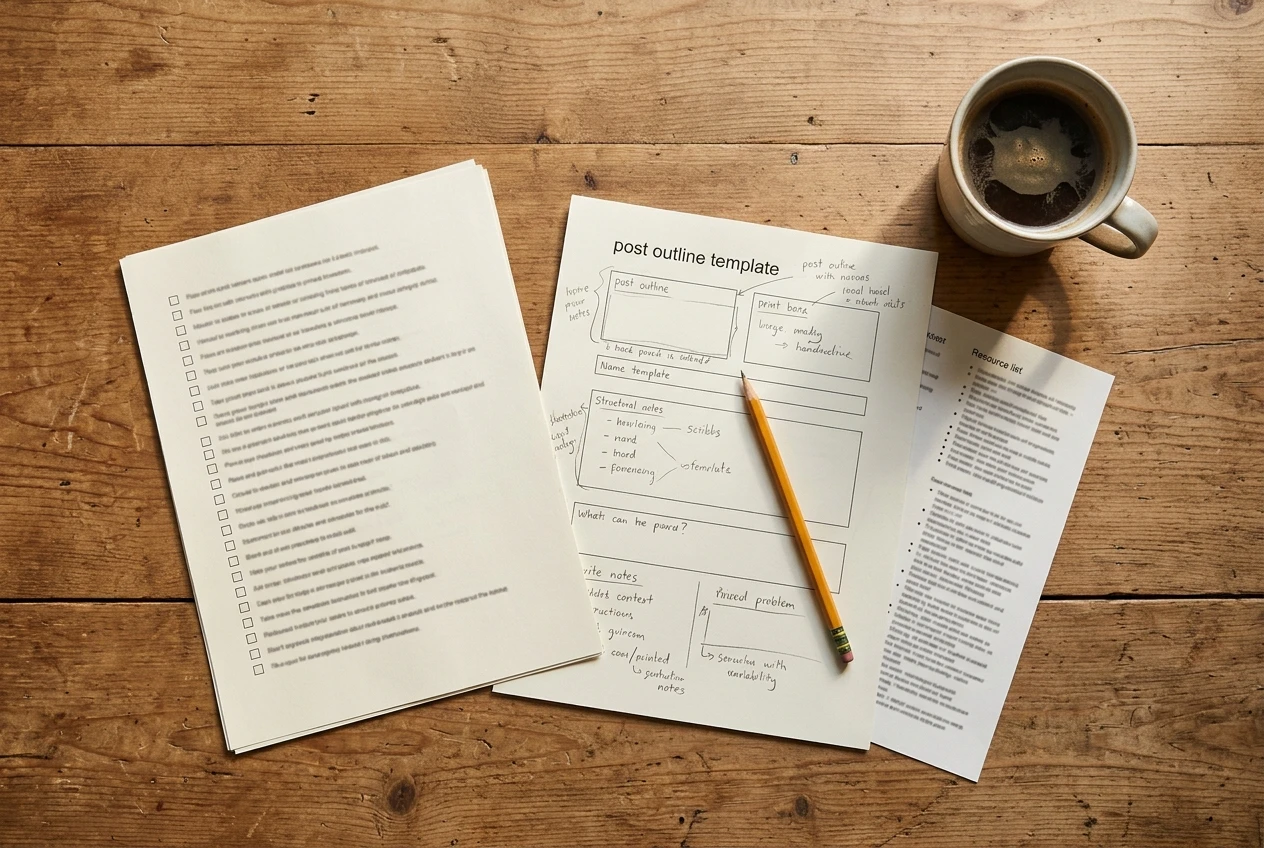
- A checklist. One page of steps for a task your readers already search for, such as publishing a post or auditing a page before it goes live.
- A template. A fill-in outline for a review post, a comparison post or a content calendar.
- A short email course. Three to five emails delivered automatically after signup, each teaching one small thing.
- A resource list. A curated set of tools or links with one sentence on when to use each.
The test for a lead magnet is whether someone can use it within fifteen minutes and get a real result. If it takes an hour to understand, it is too big for a first version.
Match the magnet to the promise from the previous section.
If your promise is “publish your first five posts with a clear structure,” a post outline template is a direct fit.
A general SEO cheat sheet is a weak fit, even if it sounds more impressive.
Build it with tools you already have.
A word processor or a free design tool will do, saved as a PDF. If you choose an email course, your email service can send it automatically, which doubles as practice for the welcome sequence later.
Then give it a plain name that states the result. “The One-Page Post Outline” tells the reader what they will receive. “Ultimate Affiliate Success Blueprint” doesn’t.
Verdict: keep one small, specific magnet that you can ship in two days. Drop the ebook idea until the list is growing and you know what subscribers ask for.
Put signup forms on the posts that already get read
The posts that already attract readers are where signups will come from. Starting there is the fastest route to your first subscribers.
First, find those posts. Open your site analytics or Search Console and sort your pages by clicks or visits over the last three months.
Pick the top five. If you want a method for turning that data into decisions, the guide on turning your affiliate data into a 90-day content plan covers it in detail.
Then place a form in three spots on each of those posts:

- Inside the post, after the first major section. By this point a reader has seen that the post is useful, and a short invitation feels natural.
- At the end of the post. Readers who finished the article are the most interested group, so use a slightly longer pitch here.
- In the sidebar or a pinned bar, if your theme supports it. This is the weakest position, so treat it as an extra.
The text around the form matters more than its design.
Say what the reader gets and what it helps them do: “Download the one-page post outline and publish your next article in an afternoon.
” Then add a button that states the action, such as “Send me the outline.”
Ask for as little as possible. An email address is enough, and a first name is optional. Each extra field lowers the number of people who finish.
Where you can, match the offer to the post.
A reader on a post about writing product reviews will respond better to a review template than to a general newsletter.
Even a sentence of context before the form helps: “If you’re writing your first review, this outline saves you the blank page.”
Test one thing at a time. Leave the forms in place for a few weeks, then check how many visitors on each post signed up.
Move or reword the weakest form and leave the strongest one alone.
Verdict: keep in-post and end-of-post forms on your five most-read pages. Drop pop-ups that appear within seconds of arrival, since they interrupt readers before they know whether your site is worth their address.
Write the first five emails: help first, recommend second
Once someone subscribes, the first emails decide whether they stay. This sequence runs automatically and every new subscriber receives it in order.
The principle is simple. Give useful help in the first emails, and recommend something only after the reader has reason to trust you.
Here is a five-email structure you can adapt:
Email 1: delivery and one quick win. Send the lead magnet immediately. Tell the reader the single first action to take with it, and say what the next emails will cover.

Email 2: a common mistake and its fix. Pick one error beginners make in your topic, explain why it happens and show the correction. This works for any niche you know well enough to write about.
Email 3: your best posts, in order. Link to three of your most useful articles and say who each one is for. It sends readers back to your site and shows the depth of what you’ve published.
Email 4: a question. Ask what the reader is working on or stuck on, and invite them to reply. Replies teach you what to write next, and they also signal to mailbox providers that people engage with your messages.
Email 5: a recommendation. Explain a tool or platform that solves a problem the earlier emails raised, say plainly that you earn a commission if they join through your link, and say who it suits and who it does not.
Keep each email short. Three to six brief paragraphs is enough. Use a subject line that states what is inside, such as “The mistake that stalls most first posts.”
Write in a conversational voice, as if answering one person’s question. Mass-marketing language is easy to spot and easy to ignore.
Spacing matters too. Send the first email at once, then one every two or three days. That is quick enough to keep the memory of signing up fresh and slow enough not to crowd an inbox.
Verdict: keep four emails of real help before the first recommendation. Drop any sequence that opens with a sales pitch, because a stranger has no reason to act on it yet.
How to mention Wealthy Affiliate without sounding like a sales pitch
Wealthy Affiliate is the platform this site recommends, and you will probably want to do the same if it fits your audience.
How you introduce it decides whether the email reads as advice or as an ad.
Start with the reader’s problem. By email 5, subscribers have seen what you teach, so they likely want a place to build their site, study the skills behind it and get answers when they are stuck.
That is where Wealthy Affiliate fits, and you can say so directly.
Explain what it does and who it suits:
- It combines site building, learning and community support in one place, which helps a beginner who doesn’t want to piece together separate tools.
- It is aimed at people who want to build a website-based affiliate business over time. Someone looking for a quick payout is not the audience.
Be honest about the limits.
A line such as “this is a good fit if you want to build a site and are willing to put in regular work, and a poor fit if you are after something that pays this week” earns more trust than praise alone.
Readers can tell when a recommendation has no downside attached.
Disclose the affiliate relationship in the email itself, near the recommendation.
In the US, the FTC expects a clear disclosure whenever you earn from a link, and the same habit builds credibility with readers anywhere.
Do not invent claims. Describe only what you have verified about the platform, and send readers to the official pages for current details on features and pricing.
If you want to go deeper on the platform itself, you can link your Wealthy Affiliate review as a resource, so the email can stay short.
After the first mention, return to helpful content. A good rhythm is to recommend only occasionally, with several useful emails between each mention.
Verdict: keep one honest, disclosed recommendation tied to a problem you’ve already discussed. Drop repeated promotional emails and inflated promises, since both train subscribers to skip your messages.
Keeping the list healthy: consent, unsubscribes and a sending rhythm
A list is only worth owning if people want to be on it. Three habits keep it that way.
Consent. Subscribers should sign up on purpose. State what they will receive next to the form, and never add people who did not ask.
Readers in the EU and UK are covered by rules that require clear consent, and many email services offer double opt-in, which asks a new subscriber to confirm by clicking a link.
Double opt-in produces a smaller list with fewer fake addresses, and it is a sensible default. Rules differ by country, so check the requirements for the places your readers live.
Unsubscribes. Every email needs a working unsubscribe link, and in the US the CAN-SPAM Act also requires a valid physical mailing address.
Your email service normally inserts both.
Do not hide the link or make leaving difficult. A subscriber who can leave easily rarely marks you as spam, and spam complaints hurt your delivery to everyone else.
A few unsubscribes after each email are normal. They mean the list is sorting itself toward people who want your content.
Sending rhythm. After the five-email welcome sequence, choose a schedule you can keep. One email a week is a reasonable start for most beginners.
If you can only manage every two weeks, that works too, provided you stay consistent.
Consistency matters more than frequency.
A list that hears from you regularly remembers you.
A list that hears nothing for three months and then receives a promotion treats it as a surprise.
Review the list every few months.
If subscribers have not opened anything for a long stretch, send one email asking whether they want to stay, then remove those who do not respond.
A smaller list of readers who open your emails performs better than a larger one of silent addresses.
Verdict: keep double opt-in, an easy unsubscribe and a weekly or fortnightly schedule. Drop buying lists, adding people without permission and sending in bursts whenever you remember.
What to keep and what to drop in your first 90 days of list building
Ninety days is enough to build the whole system and see whether it works.
Here is a sensible order.

Days 1 to 14: set the foundation. Write your one-sentence promise, build the lead magnet and choose an email service. Set up the sign-up form and the automatic delivery of the magnet. Test the whole path yourself by signing up with a spare address.
Days 15 to 30: place the forms. Add forms to your five most-read posts, in the middle and at the end. Write the five-email sequence and switch it on. At this point you have a working system, even if it has few subscribers.
Days 31 to 60: send and watch. Begin your regular email, weekly or fortnightly. Check which posts bring the most signups and which emails get the most opens and replies. Read every reply, because they tell you what to write next.
Days 61 to 90: adjust. Improve what the numbers show. Reword the weakest forms, rewrite the email with the lowest engagement and consider a second lead magnet tied to a second popular post. Clean out any subscribers who never open.
Throughout this period, keep producing content. New posts bring new visitors, and every new post is another place for a form.
Some things to keep:
- One clear promise and one small lead magnet.
- Forms on the posts that already get traffic.
- Help-first emails, with an honest, disclosed recommendation later.
- A steady sending schedule you can maintain.
Some things to drop:
- Large lead magnets that take weeks to finish.
- Forms on every page regardless of traffic.
- Promotional emails in the first week.
- Complicated automation before you have a hundred subscribers.
Most of the work is setting up once and then improving it slowly.
At the end of 90 days you will have a list of people who asked to hear from you, and that list stays yours whatever happens to your rankings.
If you want one place to build the site, learn the list-building side and get support while you do it, join Wealthy Affiliate through my referral link and start with your first free exploration.
P/S:- If you join Wealthy Affiliate through my link, I may earn a small commission but without an extra cost to you!!!!!!!!!