
Most affiliate sites that already have content hit the same limit: the number of hours in a week. AI can give some of those hours back, but only if you point it at the right jobs.
Pointed at the wrong ones, it produces more pages, more emails and more posts, while rankings, reader trust and commissions stay where they were.
This article is a decision framework for existing affiliate sites. It covers which repeatable jobs to turn into workflows, which four workflows pay off most often, and which three jobs should stay in your hands.
The search for ai automation workflows for affiliate marketing usually turns up tool lists, and you can find one in Using AI Tools For Affiliate Marketing. Here the question is where to apply the tools.

Why most affiliate automation adds output but not revenue?
The easiest thing to automate is first-draft writing, so that is where most people start.
A site that goes from four posts a month to twenty has more output, but affiliate revenue depends on other things: whether a page ranks for a query with buying intent, whether the reader believes the recommendation, and whether the link still goes to a live offer with the terms you described.
Faster publishing can work against all three. Search engines can rank pages thin or repetitive if they say nothing a dozen other pages do not already say.
Readers who notice generic copy trust the recommendations less. And every new page adds links you now have to check and facts you now have to keep current.
Recurring commissions add a further reason to look elsewhere. Income from subscriptions or repeat purchases comes from pages that keep sending the right readers to a good product for months.
Protecting and improving those pages usually earns more per hour than adding new ones. The workflows below are chosen for that reason: they maintain and extend what already exists.
Audit your week: the repeatable jobs worth turning into workflows
Before building anything, write down every job you do on the site for two weeks, with the minutes each one took. Then run each job through three questions:
- Are the steps the same every time? A job you repeat with the same inputs and the same checks is a candidate. A job that changes shape each time is not.
- What happens if it is wrong? A typo in a social caption is cheap to fix. A wrong price or a false claim about a product’s features is not.
- Does it need first-hand experience? If the value of the output comes from having used the product, AI has nothing to contribute to that part.
Jobs that are repeatable, low in risk and independent of personal experience are the ones to automate. Jobs that fail the second or third question stay with you, though AI can still assist with the parts around them.
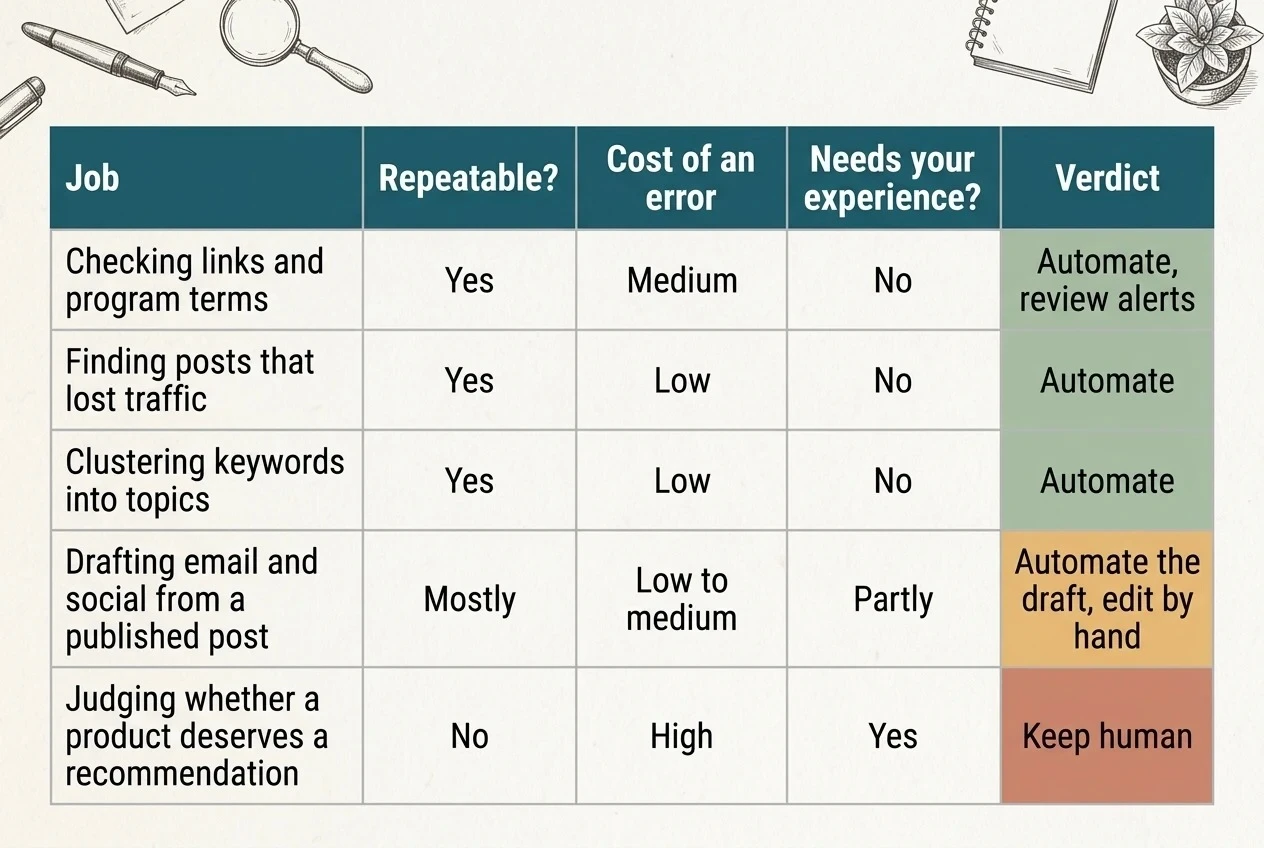
Your own list will differ, and that is the point of doing it. The table above is a starting shape, not a rule.
Workflow 1: Refreshing older posts so recurring commissions keep compounding
Older posts that already rank are your most valuable assets, and they decay quietly.
Prices change, features are added or dropped, a competitor releases something better, and the page keeps sending readers to a description that is out of date.
A refresh workflow can run in four steps:
- Export your pages with their clicks and impressions from Search Console and your affiliate dashboard, covering the last three months and the three months before that.
- Flag pages where clicks or impressions fell, and rank those by how much they earn per click. Pages promoting products with recurring payouts go to the top of the list.
- For each flagged page, ask AI to compare your headings against the pages currently ranking and list questions your page does not answer, plus any statements that look dated.
- You verify every flagged fact against the product’s own site, rewrite what is wrong, add what is missing from your own knowledge of the product, and republish.
Steps one to three are mechanical and fit a workflow well. Step four is the part that protects trust, so keep it manual.
Change the published date only when the content has actually changed.
Workflow 2: Turning keyword research into a content queue
Keyword research produces a long spreadsheet, and the slow part is deciding what to do with it.
AI is good at the sorting.
Feed it your keyword export along with a list of your existing page titles and ask it to do three things: group keywords by search intent, match each group to an existing page where one fits, and mark groups that have no matching page.
The matching step prevents a common problem, which is writing a new post that competes with one you already have.
Groups that match an existing page become update tasks.
Groups with no match become candidates for new posts, and AI can draft a one-page brief for each, with the question the reader is asking, the likely subheadings, and the type of product that would fit.
You then choose what enters the queue.
The filter is whether you can recommend something good for that query. A keyword with high commission potential and no product you would stand behind should stay out.
Your guide on keyword research techniques for niche affiliate sites covers how to judge those terms before they reach the queue.
Workflow 3: Monitoring programs, links and commission changes
This is the least glamorous workflow and often the most valuable.
Affiliate programs change their commission rates, cookie windows, payout thresholds and approved promotion methods, and some close without much notice.
A post that quotes last year’s terms misleads readers and can put your account at risk.
Build a simple tracker with one row per program: the commission structure, the cookie duration, the date you last checked the terms, and the pages that mention the program.
Then automate the checking:
- Run a link checker across the site on a weekly schedule and have the results sent to you.
- Forward program announcement emails to a single inbox or folder, and have AI summarise each one into a line such as “commission rate changed” or “payout threshold raised”.
- Ask AI to list which of your pages mention the affected program, using your tracker.
The automation finds the problem and tells you where it is.
You read the actual terms and decide what to change.
A summary of a policy change is useful for triage, but you should not edit a post based on a summary you have not checked against the source.
Workflow 4: Repurposing one post into email and social without sounding copied
One strong post contains enough material for an email, several social posts and a short follow-up.
The mistake is pasting the same text into each channel. Subscribers who read your post and then get an email containing its first three paragraphs learn to skip your emails.
A better workflow gives each channel its own angle:
- Pick one question the post answers, for example “which of these two options suits a beginner?”
- Give AI the post, two or three samples of your own writing in the voice you want, and the single angle for each channel.
- Ask for a draft that answers that one question and links to the post for the rest.
- Edit the draft so it sounds like you, remove anything you would not say, and check every claim against the post.
The email can take a different slice of the material than the social posts, which keeps your channels from repeating each other.
For channel-specific ideas, see how to leverage social media for affiliate marketing.

The jobs to keep human: recommendations, testing and disclosure
Three jobs should stay with you, because the value of each depends on a person being accountable for it.
Recommendations. Deciding that a product deserves your readers’ money is a judgment about fit, quality and honesty, and your name is on it.
AI can help you compare features, but it cannot tell you whether a product is good for the reader you serve.
The criteria in how to choose the best affiliate products to promote are worth applying by hand each time.
Testing. First-hand experience is the thing a reader cannot get from a generic page, and it is also the thing AI cannot produce.
If you have not used a product, say so plainly in the post or leave the claim out. Never let a tool write “in my experience” on your behalf.
Disclosure. Readers need to know when you earn a commission, and the rules that govern this depend on where you and your readers live.
Write the wording yourself, place it where readers see it before they click, and keep your affiliate disclosure page accurate.
Workflows can insert a disclosure line into a template, but a person should decide what it says and check that it appears on every page it should.
How to measure whether a workflow is paying for itself
Measure each workflow against its own baseline, before and after. Three numbers cover most cases.
- Time. Record how long the job took you by hand over a typical month, then how long it takes now, including the time you spend reviewing the output. Review time counts. If the workflow saves ten minutes and adds ten minutes of correction, it saved nothing.
- Errors. Count the mistakes you catch in review, such as wrong facts, off-voice copy and broken links. If the number is not falling as you improve your instructions, the job may not suit automation.
- Outcomes. For refreshes, compare clicks and affiliate earnings on updated pages against similar pages you left alone, over the same period. For email and social, compare click-through to the post. Give search-driven changes several weeks before drawing conclusions, since rankings move slowly.
Then do a simple cost check: the hours saved, valued at what an hour of your time is worth, against what the tools cost you.
A workflow that clears that bar and does not raise your error count is worth keeping. One that fails either test should be changed or dropped.
A simple four-week plan to build your first workflow
Week 1: audit and choose. Log your jobs and minutes for the week, run them through the three questions, and choose one job that scores well. A link and program check or a post refresh is a sensible first pick for most sites. Record how long that job takes now.
Week 2: write it down and build it. Write the steps as a numbered list that a stranger could follow. Mark which steps are automated and which are yours. Set up the tools for the automated steps and write the instructions you will give AI.
Week 3: run it on a small batch. Use five to ten pages or one program set. Review every output by hand and keep a note of each correction you make. Adjust the instructions after each batch so the same mistake does not repeat.
Week 4: measure and decide. Compare time and errors against your week-one baseline. If the workflow saves time without lowering quality, keep it and schedule it. If not, change the step that caused the problems and run it once more.
Add a second workflow only after the first has run cleanly for a full cycle.
Pick one repeatable job from your own week, build a single workflow for it over the next seven days, and compare the time and results before you add a second. For the tool side, see Using AI Tools For Affiliate Marketing.